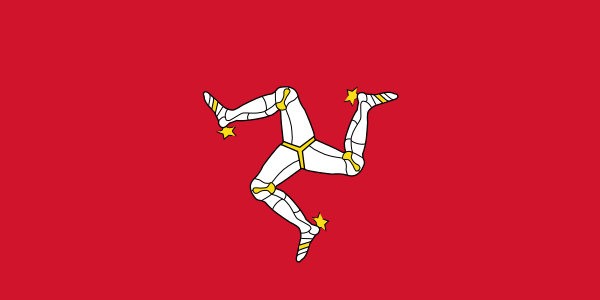
Isle of Man
Isle of Man
Current Population (Live)
Annual Growth Rate: -0.01%
As a microstate in Northern Europe, Isle of Man is home to just 84.2k people, making it one of the less populous countries in the world. Despite covering only 572 km², the territory records a density of 147 people per km². Its capital is Douglas, and official languages include English and Manx, while the British pound serves as the national currency.
Population
84,160
Area
572 km²
Density
147/km²
World Rank
#203
Population Trend (1960-2050)
Historical data from 1960 to present with projections to 2050.
Annual Growth Rate by Period
The population is currently contracting at a rate of -0% per year, pointing to deep structural challenges such as low birth rates and emigration. Deaths (10.7 per thousand) now equal or exceed births (8.3 per thousand), resulting in natural population decline. The population skews older, with 23.1% aged 65 or above and 14.2% under 15, signaling rising dependency ratios.
General Information
- Capital
- Douglas
- Region
- Europe
- Subregion
- Northern Europe
- Continent
- Europe
- Languages
- English, Manx
- Currencies
- British pound (£), Manx pound (£)
- Calling Code
- +44
- Top-Level Domain
- .im
- Landlocked
- No
- UN Member
- No
- Timezones
- UTC+00:00
Population Details
- Total Population
- 84,160
- Land Area
- 572 km²
- Population Density
- 147 per km²
- Annual Growth Rate
- -0.01%
- Annual Growth
- -8 people
- Daily Growth
- -0 people
- World Population Share
- 0.00%
- Coordinates
- 54.25°, -4.50°
Global Population Share
Demographics & Economy
With a GDP per capita of roughly $88.3k, Isle of Man sits comfortably in the high-income bracket by World Bank standards.
Life Expectancy
81.1 years
GDP per Capita
$88,329
Birth Rate
8.3 per 1,000
Death Rate
10.7 per 1,000
Urban Population
52.2%
Fertility Rate
1.54 births/woman
Under 15
14.2%
Over 65
23.1%
Age Distribution
0-14 years
12K
15-64 years
53K
65+ years
19K
Urbanization
About 52.2% of the population is urban, indicating a society in the midst of a rural-to-urban transition. Douglas serves as the administrative heart of the country and concentrates much of its commercial and civic life. Net inward migration of 166.0 per thousand is contributing to urban growth and reshaping community demographics.
43,898
52.2%
40,262
47.8%
Health & Education Indicators
Life expectancy reaches 81.1 years, ranking among the highest globally and reflecting robust healthcare systems and living standards.
Life Expectancy
World avg: 72.8
Fertility Rate
World avg: 2.3
Population Projections (2026-2050)
If current trends persist, Isle of Man's population will continue to shrink, intensifying labor shortages and increasing the burden on pension and healthcare systems. With 23.1% of the population already over 65, the aging challenge is likely to deepen in the decades ahead. The territory's governance arrangements will influence how effectively it adapts to evolving population dynamics.
| Year | Projected Population |
|---|---|
| 2026 | 84,160 |
| 2030 | 84,080 |
| 2035 | 83,885 |
| 2040 | 83,600 |
| 2045 | 83,238 |
| 2050 | 82,812 |
Isle of Man Crime Rate & Safety
Homicide statistics, crime trends, and travel safety information for Isle of Man.
Frequently Asked Questions
What is the population of Isle of Man?
The population of Isle of Man is approximately 84,160 as of 2026, making it #203 in the world by population.
What is the capital of Isle of Man?
The capital of Isle of Man is Douglas.
What languages are spoken in Isle of Man?
The main languages spoken in Isle of Man are English, Manx.
How big is Isle of Man?
Isle of Man covers an area of 572 km² with a population density of 147 people per km².
Is Isle of Man growing or shrinking?
Isle of Man's population is declining at a rate of -0.01% per year.
What is the life expectancy in Isle of Man?
The average life expectancy in Isle of Man is 81.1 years.
What is the GDP per capita of Isle of Man?
The GDP per capita of Isle of Man is $88,329.