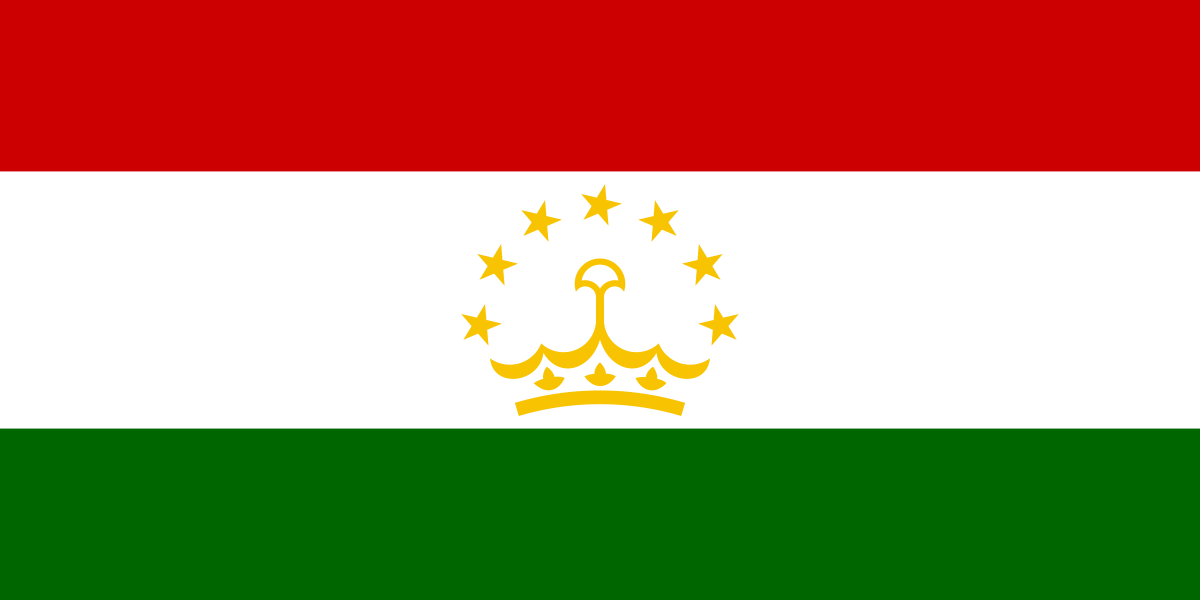
Tajikistan Crime Rate & Safety
Homicide statistics, crime trends, and travel safety for Tajikistan
US State Department Travel Advisory
Exercise Increased Caution
Updated May 16, 2025
Tajikistan recorded 0.9 intentional homicides per 100,000 people in 2020, a rate that is among the lowest in the world. That places Tajikistan #157 of 195 countries by homicide rate, compared with the Asia average of 2.0 per 100,000 and a world average of 5.2. Homicide rates have fallen 62% over the past decade (from 2.4 in 2010). For travelers, the US State Department currently rates Tajikistan at Level 2 of 4: Exercise Increased Caution.
Homicide Rate
0.9 /100k
Safety Rank
#39 of 195
Travel Advisory
Level 2 of 4
Data Year
2020
Homicide Rate Trend (1990-2020)
Intentional homicides per 100,000 people. Homicide rates have fallen 62% over the past decade (from 2.4 in 2010). Source: UNODC via World Bank.
How Tajikistan Compares
Intentional homicides per 100,000 people, latest available year per country.
Who Is Affected
In Tajikistan, the homicide rate for men is 8.1× higher than the rate for women — 1.6 vs 0.2 per 100,000 (2020).
Homicide victims per 100,000 of each sex. Source: UNODC via World Bank.
Armed Conflict Context
Tajikistan has recorded battle-related deaths in recent years. Conflict deaths are counted separately from homicides — a country can have a moderate crime rate but significant conflict risk, and travel advisories weigh both.
Battle-Related Deaths
87(2022)
Military Spending
1.9% GDP(2024)
Safety for Travelers
Summary of the current US State Department advisory for Tajikistan:
Reissued after periodic review with updates regarding the resumption of cross-border movement between the Kyrgyz Republic and Tajikistan. Exercise increased caution in Tajikistan due to the risk of terrorism, unexploded landmines, occasional violence near the border with the Kyrgyz Republic, and limited ability to assist U.S.-Tajik dual nationals . Some areas have increased risk. Read the entire Travel Advisory. Reconsider travel to : Tajikistan's border with Afghanistan due to terrorism . Gorno-Badakhshan Autonomous Oblast (GBAO) due to the potential for armed conflict .
Level 1
Exercise Normal Precautions
Level 2
Exercise Increased Caution
Level 3
Reconsider Travel
Level 4
Do Not Travel
Safety Guidance for Tajikistan
Practical safety information for visitors, from US State Department country information (last updated July 18, 2025).
Terrorism
Terrorist groups and individuals inspired by them want to attack U.S. citizens outside of the United States. They are using simpler methods of attack like knives, guns, and vehicles to target crowds. They often go after unprotected or vulnerable targets. High-profile public events (sporting contests, political rallies, demonstrations, holiday events, celebratory gatherings, etc.) Hotels, clubs, and restaurants frequented by tourists Places of worship Schools Parks Shopping malls and markets Public transportation systems (including subways, buses, trains, and scheduled commercial flights) Terrorist organizations, including ISIS, have a presence in the region. Their activities mostly include recruiting supporters online and through social media, with the aim of conducting terrorist attacks in Tajikistan and other countries.
Border Areas with Afghanistan
Reconsider travel near and along Tajikistan’s border with Afghanistan due to terrorism. The current political situation in Afghanistan creates a challenging and unpredictable environment in the border areas due to evolving security conditions. The land border between Tajikistan and Afghanistan was closed after the Taliban takeover in 2021. Currently, only “Panji Poyon” border crossing is open for land travel between the countries. Travel in the mountainous region along the Afghan border can be dangerous due to the proximity of militant groups across the border. The Department of State Travel Advisory for Afghanistan is currently at Level 4: Do Not Travel. Please read the Travel Advisory if you are considering traveling near the Tajik-Afghan border. Militant groups have attempted cross-border rocket attacks and armed incursions into Tajikistan.
Restricted Zone of Gorno-Badakhshan
Reconsider travel to Gorno-Badakhshan Autonomous Oblast (GBAO). Do not enter the Gorno-Badakhshan (GBAO) region without official permission. If you enter without permission, Tajik law enforcement may detain you. Violent clashes with security forces have occurred in GBAO in recent years. Tajikistan may suspend travel permits for non-Tajik citizens on short notice. To enter this restricted zone, request a special permit from a Tajik embassy or consulate, or from the MFA’s Main Consular Department or OVIR, if applying within Tajikistan. Submit your request at least 2 weeks before your trip. If granted, authorities will list in your passport the names of authorized cities and other destinations. If applying for an e-Visa for tourism, you can apply for official permission to visit GBAO at the same time, for an additional fee. Please visit Tajikistan’s e-Visa website for more information.
Border Areas with the Kyrgyz Republic
Stay alert when traveling near, along, or through the Tajikistan-Kyrgyz Republic land border. There have been armed conflicts between Tajik and Kyrgyz border guards, as well as between civilians and residents, over the past 5 years—particularly in the Isfara area and the Vorukh enclave. Bilateral agreements between the Kyrgyz Republic and Tajikistan have led to more travel at the Guliston–Kyzyl-Bel and Madaniyat–Kayragach border crossings.
Landmines
and unexploded cluster munitions are a hazard along the Afghan-Tajik and Uzbek-Tajik borders, as well as in the Vakhsh and Rasht valleys. Follow all posted landmine warnings. Do not leave roadways in any areas marked with red and white plastic tape. Avoid roadside ditches, shoulders, and unmarked trails. Never touch anything resembling unexploded munitions.
Crime
Crime in Dushanbe is moderate. Incidents are not usually violent. Muggings, armed robberies, and pickpocketing sometimes occur. Police do not provide adequate or immediate assistance and often will not investigate minor crimes. Drug trafficking may occur and may lead to violent crime. Travel in pairs, especially at night. Sexual harassment of women traveling alone is common. Carry a copy of your passport with you at all times.
Scams
Review the Department of State’s Protecting Yourself from Scams and the FBI pages for information.
Technology Usage Abroad
Mobile devices can be compromised, stolen, or damaged anywhere in the world. Before traveling abroad, it is best to keep all software (operating system and apps) updated. If possible, use a virtual private network (VPN) and encrypted voice over IP (VoIP) applications. Make sure that all VPN/VoIP are reputable, and U.S. based. Do not connect to unknown open Wi-Fi. GPS Navigation Apps are helpful in getting U.S. citizens around in a foreign country. Prior to using the GPS app make sure you research the route to make sure it is safe. GPS navigation app may give you the shortest route without safety consideration.
Victims of Crime
U.S. citizen victims of sexual assault are encouraged to contact the U.S. Embassy for assistance. Report crimes to the local police by dialing 102 from a cell phone and contact the U.S. Embassy at +992-37-229-2300. Local authorities are responsible for investigating and prosecuting crime. U.S. citizen tourists who are victims of crime can contact Dushanbe Tourist Police at 0200 from any part of the country to report the incident and seek further assistance. Review our webpage on help for U.S. victims of crime overseas . We can: Help you find appropriate medical care. Assist you in reporting a crime to the police. Contact relatives or friends with your written consent. Provide general information regarding the victim’s role during the local investigation and following its conclusion. Provide a list of local attorneys. We do not endorse or recommend any specific attorneys.
Domestic Violence
U.S. citizen victims of domestic violence are encouraged to contact the Embassy for assistance.
About This Data
Homicide figures are intentional homicides per 100,000 people, compiled by the United Nations Office on Drugs and Crime (UNODC) and published by the World Bank (indicator VC.IHR.PSRC.P5). Homicide is the most reliably comparable crime statistic across countries because definitions of other offences (assault, theft, robbery) vary widely between national legal systems and reporting practices.
Travel advisory levels are issued by the US Department of State and updated continuously. They reflect risks to travelers including crime, terrorism, civil unrest, health, and natural disasters — not only crime rates. Countries report crime data with different lags; the most recent available year is shown for each metric.
Tajikistan Population & Demographics
Population of 10,590,927, growth trends, economy, and more.
Crime & Safety in Neighboring Countries




Frequently Asked Questions
Is Tajikistan safe to visit?
The US State Department rates Tajikistan at Level 2 of 4 (Exercise Increased Caution). The homicide rate of 0.9 per 100,000 is among the lowest in the world.
What is the crime rate in Tajikistan?
Tajikistan has an intentional homicide rate of 0.9 per 100,000 people (2020, World Bank/UNODC), ranking #157 of 195 countries.
What is the US travel advisory level for Tajikistan?
Tajikistan is currently at Level 2: Exercise Increased Caution. Advisory levels range from Level 1 (Exercise Normal Precautions) to Level 4 (Do Not Travel).
How does crime in Tajikistan compare to other countries?
Tajikistan's homicide rate of 0.9 per 100,000 is below the world average of 5.2 and below the Asia average of 2.0.